Tuesday, March 9, 2010

WALT'S PEOPLE-President Ronald Reagan

WALT'S PEOPLE-Ronald Reagan
by Paul F. Anderson

On my very first visit to the Ronald Reagan Presidential Library in California, many years ago, I did a bit of research on the profound friendship shared by Ronald Reagan and Walt Disney. The bond was so strong, that Walt asked Reagan be one of the opening day hosts for Disneyland (along with Bob Cummings [center] and Art Linkletter [right]) for the ninety-minute coast-to-coast live television broadcast on July 17, 1955. Reagan was flattered and willingly obliged.

After Walt's passing, Reagan (then Governor of California) recommended that a United States postage stamp be issued to honor Walt. In his 1967 letter to the Postmaster General, Reagan declared his feelings about his old friend:
"I hesitate to even mention California's pride in his vast accomplishments for fear of detracting from his true image as a world-renowned and world-beloved figure. There is no necessity for me to itemize his contributions to humanity; they can be summed up by simply saying that because of him the world is a richer, better place."

Monday, March 8, 2010

WALT DISNEY QUOTE-Perfection

"Whenever I go on a ride, I'm always thinking of what's wrong with the thing and how it can be improved."

Sunday, March 7, 2010

SUNDAY FUNNIES-An Ode to Elliott

THE SUNDAY FUNNIES


Welcome to a new feature here at the Institute. Pull up your favorite comfortable lounge chair, grab your cozy loafers, and shake out your favorite virtual comics section from the newspaper--it's time for The Sunday Funnies here at the Disney History Institute.

Over the decades here at the Institute I was always on the lookout for non-Disney cartoons that were in some way related to Disney. As you might imagine, since Disney dominates our popular culture, there are a lot of cartoonists that "use" Disney in their work. So check in here at the Institute every seven days for The Sunday Funnies.

The inaugural offering has several layers of Disney to it. American cartoonist Bil Keane was born in Pennsylvania in 1922. His cartoon The Family Circus first appeared in newspapers on February 29, 1960 (Leap Year) and continues today in syndication. King Feature Syndicates, the publisher, claims it is the most widely syndicated cartoon in the world. The inaugural offering for The Sunday Funnies dates from February 21, 1978.

The caption reads: "Let's sit in the back near the candy counter." (Click on the cartoon for a larger image.)

The Disney film Pete's Dragon was released on November 3, 1977. As most of you Disney history die-hards have probably already located, this Sunday Funny features Elliott the Dragon from the film (look towards the back of the cartoon to see the movie playing and Elliott in his typical happy incarnation). This is the first layer. The second?

The second layer features a young animator that left Cal Arts in 1974 to work for Disney animation. His first work was done under the tutelage of Nine Old Man Ollie Johnston for The Rescuers (1977). Shortly after this work he went on to do animation on Elliott the Dragon for Pete's Dragon. His name was Glen Keane, and many of you know that he became a superstar of Walt Disney Feature Animation. It just so happens, his dad was Bil Keane and so it was a father paying homage to his son that brought Elliott to the Family Circus. And now, as Paul Harvey would say, "You know the rest of the story."

Friday, March 5, 2010

BRER RABBIT "Says 25 Free Trips to Disneyland"

The DHI staff was sitting around the board room table today, as we do each month, and one of the archivists (young whipper snapper!) said that our blog needed more color. Our illustrious founder agreed, and fortunately we have the DHI DCBAPP (Disney Comic Book Advertising Preservation Program) underway (imagine). So here from Walt Disney Comics and Stories #187 (April 1956) is the full-page back cover advertisement. If the Disneyland television show was not enough to make us baby boomers promise anything to our parents to "take us to Disneyland" ... then this graphically pleasing, and colorful, admonition from Brer Rabbit himself would have certainly pushed us over upon receiving our monthly subscription copy of the comic. (Click on the image for a crisper and larger Brer Rabbit!)

Thursday, March 4, 2010

DISNEY AND THE MAGAZINE-Chocolate Frosted Sugar Bombs

Disney and the Magazine
Modern Millwheel of General Mills August 1955
by Paul F. Anderson

Regular guests here at the Institute know that there is an ongoing celebration of Walt Disney's use the magazine for promotional purposes (see November 2009 DHI Essay: Disney and the Magazine). The Modern Millwheel of General Mills was not a periodical one could run down to the drug store and pick up "off the rack." It was instead a publication intended for "the men and women of General Mills." In Disney parlance, it was a "cast member" publication that kept the employees of the consumer foods company up to date with the exciting world of packaged foods; this would also include from time to time information on the television shows the company was sponsoring. Enter Walt Disney. This particular issue announced three new television shows General Mills was adding to their line-up for the upcoming new TV season. Obviously, based on the cover, the emphasis was being placed on the Disney show (the other two were westerns), which was The Mickey Mouse Club. In fact, the cereal giant was so enthused about this show over the shoot 'em ups, it gave the mouse the cover and also offered the following statement to its employees: "The one likely to receive the noisiest welcome is Walt Disney's Mickey Mouse Club." The cover gives a great picture of what was happening in the summer of 1955, and it is apparent that General Mills was hoping for some shirt-tail riding! When this issue came out, America was at the zenith of the Davy Crockett craze (isn't there a book by that name?) and as such, Mickey is sporting his Coonskin Cap (although I have trouble recalling the Alamo being made out of cereal boxes...although that might have made a great slogan, "REMEMBER THE CHEERIOS!").

So what was the product to advertise to the wee ones? What else, sugar ... in the form of cake and (with all apologies to Bill Watterson) cereal! "General Mills' ready-to-eat cereal products--Wheaties, Cheerios, Sugar Jets, Trix, and Pick-A-Pack, jointly with Betty Crocker cake mixes--will sponsor two 15-minute periods each Monday, Wednesday, and Friday," proclaimed the magazine! For the sponsorship, Walt told the good folks at General Mills that the Club was tailored for 12- or 13-year-old children and "will bring all the younger ones along. " The article also goes out of it way to report that Walt's co-workers state he "makes a point ... of talking 'straight out' at youngsters instead of down at them." ABC network executives also put in their two cents worth: "Children are the audience that Disney loves and understands best." One guesses that Walt did not approve that comment, as he distinctly stated on several occasions that his films were for the entire family; but that is another story, and another magazine, for another day here at the Institute.

Wednesday, March 3, 2010

FAMOUS DISNEY DUCKS~Disneyland's Gertie

"GERT"

When one thinks of famous Disney ducks, usually thoughts of Donald Duck and his nephews come to mind. Those of us that are fond of Carl Barks would happily add the likes of Uncle Scrooge and a host of others. One that may not be on the tip of your tongue, is Gertie! In the DHI Archives, we have several original Disneyland publicity files from the 1950s. Not only do these files have the press releases that feature the stories that have fond their way into Disneyland lore, but there is also a good number of press releases that were, well, never released. Often, they are hand written and/or typed, and feature pencil corrections. And for fifty years they have languished in these files without ever seeing the light of day. And as you might have already surmised, one of them gives us Gert's story. From a 1956 unreleased, unpublished Disneyland press release:

"Ever hear the expression, 'He's a lonely duck"? Well, Disneyland has a lonely duck, and it isn't Donald. It's Gertie.

"Gertie came to Disneyland via devious ways, but with it all, she's a lady of breeding. As such she remembers the first rule for young ladies alone in the world--never speak to strangers. It's probably with this thought in mind that Gertie remains aloof. With dozens of companions of the duck world--ranging from plain white backyard ducks to long-legged cranes, teal and mallard with their colorful necklaces--Gertie prefers human companionship.

"Her first hours in the light of day saw her as a prize at a fun fair in Anaheim last spring. She was won by local residents who left the next day for their Lake Arrowhead Estate with Duckling Gertie tenderly in tow. Gertie's girlhood was a round of swimming parties in lovely Lake Arrowhead where she mingled with other ducks in the fashion world.

"By now she was referred to as a 'Pekin' duck and had become quite a personality. Such a personality, in fact, that when the family returned to Anaheim from their summer stay at the lake the feathered member of the family found it hard to adjust to living alone while her foster parents tended to business.

"At this point a society editor in the area offered to take Gertie when she heard that snails were her favorite diet. However, neighbors had put out snail bait and in short order Gertie's favorite dish was unavailable. The Society Editor, with Gertie's happiness in mind, contacted Disneyland and officials there agreed that the 'Rivers of America' in Frontierland might be just the solution for Gertie.

"Forthwith, she was brought to Disneyland, and launched into the 'Rivers of America' from aboard the Mark Twain, the old-time paddle-wheeler, typical of those that plied America's waterways at the turn-of-the-century.

"Since then, Gertie has considered the 'Mark Twain' home base and frequently flaps aboard to quack at visitors, much to their surprise and delight. When she isn't snubbing her fellow ducks or aboard the riverboat, she dismissed some of her more lofty ideals to beg for good from dinners at one of the many eating places in the park."
IMAGE: In looking for some famous Disney Ducks to show, I found this personal photo taken by Carl Barks featuring his art studio and a painting that he had just completed. In searching DHI Photo Library I was, sadly, unable to find a photo of Gertie, so in my mind this justified something by Barks. The image features Barks' painting "Truant Officer" as well as a copy of Walt Disney Comics & Stories #100 (1949) that he used for inspiration.

Tuesday, March 2, 2010

COMING TO A THEATER NEAR YOU~Mickey Mouse Sound Cartoons

From the DHI Archives: One of the earliest Mickey Mouse advertisements for the Eastern film and theatrical community. From the New York Film Daily 1929.

Monday, March 1, 2010

FANTASIA'S "HEWLETT-PACKARD IN D MAJOR"

The story of Walt Disney characters helping to save companies during the Great Depression is well known. We have all heard how Ingersoll Watch Company (now Timex) and Lionel Train Company would not be around today if not for Mickey Mouse and the gang. It leads one to wonder what other companies may not have made it without Disney. One possibility is HP (Hewlett-Packard) the computer giant. When Hewlett-Packard co-founder David Packard passed away in the mid-1990s, my eye happened to catch an item buried in his obituary in the Los Angeles Times. And I quote: "The company's first product was an audio oscillator, and among their first customers was Walt Disney Studios, which used the device in making the movie Fantasia." Just think, if the film had become a true "concert" feature as Walt had planned on, one of the follow-up sequences could have very well been "Adventures in an Oscillator." Had Roy E. Disney picked up on this for Fantasia 2000, there would have been an actual piece of music written for the animation. Classical composer Alvin Lucier's "Septet For Three Winds, Four Strings And Pure Wave Oscillator," composed in 1985.

Friday, February 26, 2010

AMERICA'S "POET LARIAT" REMEMBERS WALT DISNEY

THE TWO DUBYA'S ~ WILL AND WALT
By Paul F. Anderson

Will Rogers was one of America's favorite humorists, up there with the likes of Benjamin Franklin, Mark Twain, Ogden Nash, Stan Freberg, Garrison Keillor, and many more. In the 1920s and 1930s his influence was keenly felt through the cinema and radio, as he kept Americans laughing through a good part of the Depression. He was our "cracker-box philosopher" to use Will's self-effacing and clever wit (the "poet-lariat" is also his work, making clever use of his use of words and the rope).

One of his favorite sayings (often spinned in a drawl, while at the same time spinning his lasso) was that he never met a man he didn't like! One would be hard pressed to find a man (or woman) that didn't like him, although there were a few. For the most part Americans loved him, because he was a true American and was living the American Dream. A famous historian wrote about him: "Like America, when Will Rogers started out, a wad of gum in his jaw, twirling a rope, a grin on his face, he didn't know where he was going. His was no planned, educated, groomed, scientifically test-tubed existence. That's why it is so American." Will Rogers was America. One man that Will really liked, and the feeling was mutual, was Walt Disney (the image above feature's the two dubyas at the Writer's Club banquet in 1933--note the obvious and overwhelming admiration on Walt's face).

The two had become good friends early in the 1930s, while both were at the genesis of the popularity in their chosen careers of entertainment. The two also shared a common interest in the game of Polo, and several times Walt had played Polo with Will at the Rogers Ranch in California. It was only natural for the two to talk about doing a project together.

In 1932 Walt was contemplating a full-length animated feature based on Washington Irving's Rip Van Winkle. The film would star his friend Will Rogers, who was planned for the starring roll, the Dutch Colonist who mislays twenty years of his life after drinking with the strange little men of the Catskill Mountains (Will Van Winkle). It was not to be however, as Paramount owned the rights to the book and after much wrangling they refused to grant Disney permission. No doubt the thought of a competitor, especially with the likes of a blockbuster box office potential of the Walt and Will team, lead Paramount to their senses. The result was the friends first potential project was shelved, but they continued to discuss other possibilities. Will did make a cameo appearance in the 1933 Mickey Mouse cartoon Mickey's Gala Premiere, but little else developed.

Their mutual interest in the sport of Polo was what brought the dynamic duo back together, and once again the pair were in talks about a possible collaboration. Walt honored Rogers by selecting him to be one of four Hollywood stars chosen for a "starring" roll in the 1936 Mickey Mouse cartoon Mickey's Polo Team. The cartoon was to feature a Hollywood Polo game between the Disney characters and the stars of the silver screen. Four Hollywood stars would represent the cinema, complete with a cheering section of many "lesser" stars (one wonders if it was section "B"?). This Hollywood Polo team was to play the Disney Stars Polo team. The stars would be caricatures, which most likely grew out of the popularity of Mickey's Gala Premiere. An additional Disney touch was added with the idea that each horse would also be a caricature of the star. The cartoon is brilliantly executed, and to this day, even with its excessive dating, it is a well-loved Mickey Mouse short.

Tragically Roger's scene never made the cartoon, as his untimely death in an airplane accident with Wiley Post in 1935 prompted Walt to remove the sequences. At the time of his death Will Rogers was the top moving-picture box-office attraction, radio entertainer, newspaper columnist, after-dinner speaker, and lecturer in the United States. It was a life cut tragically short, and a world often wonders what Will witticisms we have missed, and what other potential Will and Walt projects may have developed.

The Writer's Club banquet photograph at the head of this essay gives us a glimpse into the fondness Walt had for Will, but what did Will think of Walt? The two were obviously friends, had discussed joint projects, played a beloved sport together, and shared Midwestern roots. Yet, someone with a career based on his use of the English language, what would that person's words about Walt be? In the book The Autobiography of Will Rogers, (Houghton Mifflin, Boston, MA, 1949), edited by Donald Day (actually a collection of Will's writings, speeches, newspaper columns, letters, etc.) we get a glimpse into Will Rogers thoughts and feelings through his writings on Walt. The aforementioned header photograph plays an important part in the excerpt that is to follow. The evening together prompted Will to write the following in his newspaper column:
"We were all down to a might fine dinner they gave to Walter Disney. He is the sire and dam of that gift to the world, 'Mickey Mouse.' Now if there wasent [sic] two geniuses at one table, Disney and Charley Chaplin [sic]. One took a derby hat and a pair of big shoes, and captured the laughs of the world, and the other one took a lead pencil and a mouse, and he has the whole world crawling in a rat hole, if necessary, just to see the antics of these rodents. But there was more than shoes and pencils and derby hats and drawing boards there. Both had a God given gift of human nature. Well of course they base it all on psychology of some kind and breed, but its something human inside these two ducks that even psychology hasent [sic] a name for." October 15, 1933.
The film review side of Rogers prompted the pundit to write his thoughts about Walt's work, in his nationally syndicated column following the release the Silly Symphony Three Little Pigs (1933). Will had this to say about the film: “. . . that Three Little Pigs, why I would have given my life just to have played one of them. That’s the best picture ever made.”

AFTER WALT: Will Rogers was honored by the WED Imagineers, who were no doubt aware of the friendship with Walt, when the cowboy-humorist was given a place of distinction at EPCOT Center's An American Adventure. He is one of only thirty-five Audio-Animatronics figures to make an appearance in the original show.

Thursday, February 25, 2010

CAPTAIN NEMO REMEMBERS DISNEY...And Indirectly, Walt Too

JAMES MASON AND HIS DISNEY DAYS
By Paul F. Anderson

James Mason gave an impressive performance as Captain Nemo in Walt Disney's production of 20,000 Leagues Under the Sea (1954). His cinematic portrayal of Jules Verne's mysterious antihero was every bit the equal of his renowned co-stars, Kirk Douglas (Ned Land) and Peter Lorre (Conseil)--so much so, that it is generally considered to be perhaps the most memorable film of his career. Thanks to Walt, it was also one of the most memorable experiences of his life.

Mason did not have much direct contact with Walt during the production of the film, but he did get a rare glimpse of how the "boss" ran things. And he was impressed. Consider that Mason's career spanned fifty years through Hollywood's golden age, and encompassed over 120 films. Consider that he was one of the more well-traveled actors in tinsel town, who was all too familiar with how the studios operated. With this in mind, his memory of working for Disney is a powerful example of Walt's vision and how that vision translated into running a studio. In an interview, James Mason was asked about his association with Walt Disney and the film, to which he commented:
"It was a splendid film, because it incorporated everything the Disney people do best. The model work and the special effects were outstanding as well as the creative imagination brought to the whole project. As a production it could not have been bettered. In fact, it was a producer's film rather than an actor's or director's film. I recently saw it dubbed into German, and the character I played, Captain Nemo, seemed to me to have improved immeasurably with a thick German accent. Kirk Douglas sounds pretty good in German as well. I was a bit reluctant to accept the part at first because Nemo is basically a serious, dramatic part in a film primarily aimed at children--and I wasn't sure whether I could find the right key. But I'm glad I did it, if only for the happy experience of working in the Disney Studio which, I discovered, was the only studio in Hollywood that didn't have a hierarchy of executives who passed the buck and shifted papers on their desks. It was a happy, outgoing studio, more like a university campus, really, than a motion picture factory. The Disney people seemed more alive than their other Hollywood counterparts--more stimulating, and in general nicer!"

THE MICKEY MOUSE MYSTERY OF THE ORPHAN'S STOLEN MILK ... To Be Solved Soon

Very sorry for the absence these last three weeks or so. I am sure everyone has been spellbound as to what kind of notorious Disney villain would have stolen Grisham's Milk from Mickey's Orphans (is Pete up to his old tricks? Tune in soon!). Consider this a modern-day serial, a cliffhanger if you will. I will put up the essay on Grishams Dairy here shortly.

Thursday, February 4, 2010

JUST WHO IS GRISHAM'S DAIRY ... Teaser

THE MYSTERY OF "GRISHAM'S MICKEY MOUSE"

Since today can be Help Wanted Day here at the Institute, I thought I'd throw this tidbit out there. I was recently going through the Institute's collection of Mickey Mouse comic strips, with the idea of posting a few here at DHI (more on this in the next few days). In doing so, I ran across a few of the above "extended" Mickey Mouse comic strips. I do have quite a bit of research material on this facet of Disney history for tomorrow's essay (as well as some nice early Mickey graphics); but I am always interested in more (being the OCD Historian that I am). I'd be honored to hear from any of you Grisham Gumshoes that might have a piece of the puzzle! If not, watch tomorrow (which can be Hidden Treasure Day!) to see just who Grisham is; Why people are stealing ice cream from orphans (dastardly); and just what exactly Mickey Mouse has to do with this "mystery."

Wednesday, February 3, 2010

FUN FOTO-The "Unbelievable" According To Walt

WALT DISNEY'S DEFINITION OF UNBELIEVABLE
by Paul F. Anderson
Wonderful Fun Foto of Walt enjoying Carlsbad Caverns National Park in New Mexico. In early 1964 (most likely on a trip to the 1964 New York World's Fair), Walt had his pilot make a stop in New Mexico for the purpose of seeing Carlsbad Caverns.

Walt was in one of his favorite toys (no, not Disneyland, the other favorite toy), Mickey Mouse 1 (the Studio's Gulfstream airplane). With him was his wife, Lillian Disney, their daughter Sharon and her husband, Robert Brown, and the plane pilot (most likely Kelvin Bailey). All were enjoying a leisurely trip and looking forward to seeing the famous National Park site. Walt had been intrigued with the cave since reading the article "Carlsbad Caverns in Color" from the October 1953 National Geographic, and as was the norm for him he was well informed upon arrival. It appears that this issue was also along for the ride and became the in-flight reading for the trip, since it was later reported that the group had read the article.

A special tour was arranged for Walt and his party, and was given by Park Superintendent Henry During, (pictured above with Walt). During commented that Walt was interested in the "whimsical and beautiful limestone formations" that the cave was well known for...and he was not the only one. Sharon had married an Architect, and both Brown and Walt were intrigued by the abundance of "free form" limestone formations. and their variety. The wonder of the Caverns was not lost on Lillian either, who mused, "The Caverns are just wonderful, but we are going to have to go home and reevaluate ourselves." The entire group was stunned and overwhelmed by the massive size of the Caverns. Walt, thoroughly impressed by the natural spectacle, declared that the Caverns were "unbelievable."

During noticed something about Walt that I have been writing about my entire career. That he was a big kid (albeit a Genius Kid!), just fascinated by everything, as well as ever curious and wanting to know more. "I am flabbergasted...I still don't believe it," proclaimed Walt a number of times according to the Park Superintendent.

If you are intrigued to see what "flabbergasted" Walt and what he found "unbelievable" I would suggest that a trip to our country's wonderful National Park system should be in order. If you have never been to Carlsbad Caverns, then go, and I am pretty sure you'll see what Walt meant. I did.

Endnotes and Citations can be seen at: endnotes.

Tuesday, February 2, 2010

WALT'S PEOPLE-Disneyland's "Trail of Tears"


WALT'S PEOPLE--Lucille Ryman Carroll
"Tears Are Words The Heart Can't Express"
-Quote by Unknown


As mentioned in yesterday's essay, I want to devote today's post to another influential individual in my Disney history career: Lucille Ryman Carroll. I did not know Lucille while Herbie was alive, but rather met her in 1991 when she invited Ken to a lunch at her home, and Ken asked if he could bring his "son." Ken informed me that "Lunch With Lucille" would be a very proper and genteel occasion...and boy, was it! It was a very elegant lunch in an equally graceful dining room, complete with Louis the Fourteenth looking furniture, a crystal chandelier, a servant for our food, velvet napkins, and what appeared to be Bavarian China. And our feast? Tuna fish sandwiches and salad! That was Lucille, very cultured and refined, yet very down to earth and sincere. I have to say, it was the best tuna fish sandwich I have ever had, but what I truly remember was Lucille and Ken reminiscing about Herbie. Yes, I took notes. Lots of notes!

When Lucille learned I lived in Salt Lake City, she asked me if I could go look at a Circus painting by her brother that she was trying to acquire, as it also resided in Utah. The pictures she had been sent made it appear as if there was damage on the art. I agreed to take a look at it in person for her. She agreed to an interview about her brother. And so began a very lovely and wonderful friendship with a very lovely and wonderful lady! Not only did I get that interview, but she gave me so much more! She donated money to my "cause" so I could afford to do more interviews before old timers passed away. She ardently supported Persistence of Vision. She let me have access to Herbie's files and copy everything (I was in heaven!). And she completely blew me away when she gave my wife and I an original Herb Ryman painting as a wedding present. That was Lucille, always giving. She was also very passionate about her brother and his legacy, and to honor that legacy, she started the Ryman-Carroll Foundation to carry on Herbie's "artistic legacy and perpetuate his belief that to be a fine artist, you've got to learn the fundamentals of drawing early in life." (For more information go to: Ryman-Carroll Foundation)

In 1993 she told me a beautiful story that Herbie had told her back before Disneyland had become a reality. She believed that the story was not known, as her brother felt it was private and never shared it, except with her and a few close friends. I was touched by the account, which added an important missing detail to already established Disney lore. I asked her if it would be possible for me to publish it in Persistence of Vision. She responded enthusiastically that she would like that, and thought her brother would too. That was Lucille! So thanks to this wonderful lady who was always giving, I would like to present the story once again in honor of her and Herbie (with a nod to Ken).

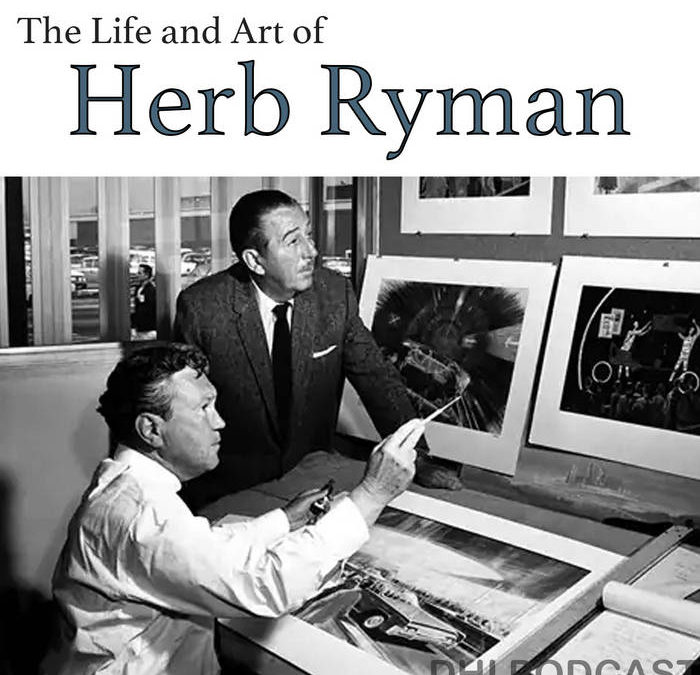
The now famous story of how Walt chose Herb Ryman to do the original Disneyland concept has become immortalized in the annals of Disney History. How Walt and Herbie spent the entire weekend working on the idea and art, so that on Monday morning Roy could take it to New York to try and get financing. Yet, in all the accounts, which have collectively been taken from Herb Ryman's recollections, one small detail was deliberately never told by Herbie. The tears! A few fortunate friends and family knew, readers of Persistence of Vision knew, and now visitors here at the Institute will also know.

Lucille reminisced with me one day about her brother's experience with Walt that eventful day in September of 1953. "Herbie wasn't going to do it; he wanted to have time to think about it. He felt that it would just embarrass himself and Walt too. What if it was turned down because the sketch was terrible?"

"Walt walked over to the corner, with his back towards me," Carroll remembers her brother telling her. "He paused, and then he turned around. There were tears in his eyes, 'This is my dream,' Walt said."

"It was at that point, that my brother decided he would do it," she recounted. "It shows the sensitivity of Walt and it shows the power he had over people. People worshipped him." Moreover, as Herbie would later recount many times, it showed how truly important Disneyland was to Walt and that Walt's vision involved Herbie. But, perhaps, without the tears, it might have never happened. A world without Disneyland would be like a world without Herb Ryman, Lucille Ryman-Carroll, and Ken Anderson ... a bit sadder! May we never forget the wonderful people that helped to make Walt's Dreams Come True!


To learn more about Lucille Ryman Carroll and her own Hollywood legacy (Ken told me that during the 1940s and 1950s she was probably one of the most powerful women in Hollywood) go to: Lucille Ryman Carroll.